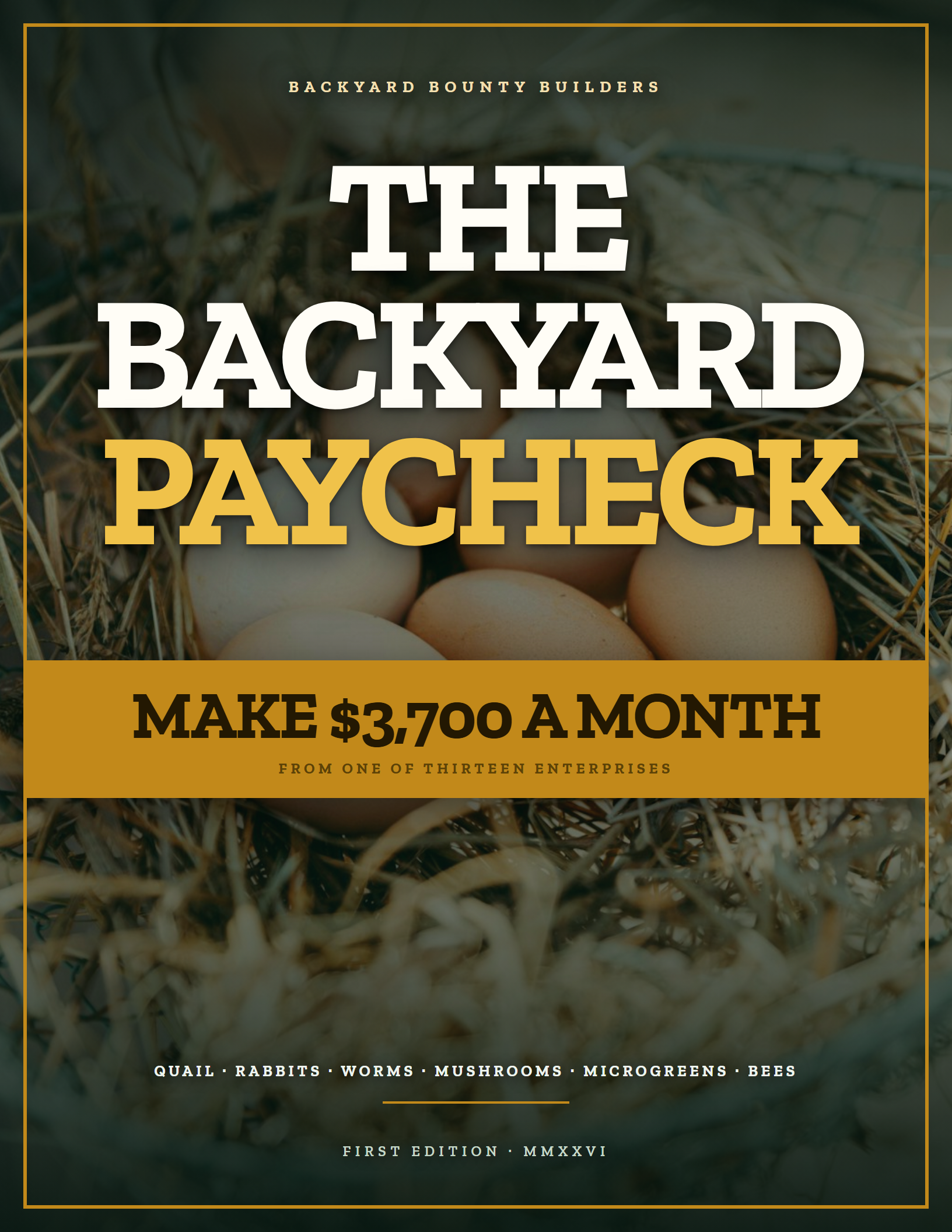
You already own the space. Now make it pay you at least $3,700 a month.
And that's from one enterprise. The book costs out all thirteen and ranks
them by what each really pays you per hour — so you can start the right one this
season, then add a second once it runs itself.
You don't have a growing problem. You have a knowing problem.
You can already raise the thing, or you could learn it in a weekend. What
nobody tells you is which thing pays, what it truly costs once the feed bill and
your own hours are in the column where they belong, and who is actually going to buy it.
So people build first and look for buyers afterwards — and eighteen months later the hutch
is on Marketplace for forty dollars.
The inversion the book is built on. It costs nothing to get right, and
eighteen months to get backwards.
Every enterprise is measured against the same three bars.
Not all thirteen clear them. The ones that fail are
in the book anyway, with the arithmetic shown — because a guide that told you all thirteen
were wonderful would be a catalogue, not a guide.
Enterprise
Per hour
Monthly net
Startup
QuailSix weeks to first egg. Kitchens, not neighbours.
$18.64
$436
$1,230
Hatching eggs & started birdsEight times the price of table eggs, from the same hen.
•••
•••
•••
Specialty table eggsFails on its own. Works as a second product.
•••
•••
•••
RabbitsSold as genetics, with meat as the byproduct.
•••
•••
•••
DucksA baker's ingredient, not a big egg.
•••
•••
•••
Feeder insectsEighteen square feet. In no ordinance ever written.
$28.89
$610
$700
Worm castingsThe only enterprise here with no feed bill at all.
•••
•••
•••
MicrogreensTwelve days from seed to invoice, on a shelf.
$24.05
$1,024
$1,000
Gourmet mushroomsHighest monthly income in the book.
•••
•••
•••
BeesNucs are the business. Honey is the visible part.
•••
•••
•••
Plant startsFifty-two cents becomes $2.80 in nine weeks.
•••
•••
•••
Heritage & specialty poultryBirds bought for a job: ticks, weeds, Thanksgiving.
•••
•••
•••
The ten that mostly don't workAnd the four conditions under which they do.
•••
•••
•••
Three shown. All thirteen ranked inside.Every figure with its costs on the same page, the hours it really takes,
and the three bars each one is measured against.
What's inside
Thirteen complete business plans, not thirteen descriptions.
Every enterprise gets the same eight sections in the same order — the buyer,
the offer, the numbers, the build, the operating year, the failure modes, the ceiling and
the first thirty days. So you can hold two of them side by side and actually choose.
Best per hour
Worm castings
$40.84 an hour on thirteen hours a month, at a 92% margin — because everything they
eat is something somebody else pays a hauler to take away.
Fastest payback
Feeder insects
Eighteen square feet in a garage corner. Silent, odourless, and absent from every
ordinance ever written. $700 in, and back inside six weeks.
Highest income
Gourmet mushrooms
$1,422 a month from eighty square feet of dark corner — and an honest account of the
seventy-two hours a month it takes to get it.
01
Why backyards don't pay
The five features that make an operation lose money, the demand-first inversion, and
the two-day territory audit that maps every buyer within twenty miles of your gate.
02
The operating system
The ten-minute calculation that tells you whether any idea can pay. Pricing that holds.
Establishing your legal floor in writing. Laying out the yard so the daily job stays under
forty-five minutes. The 90-day ramp, week by week.
03
Thirteen enterprise dossiers
Quail · hatching eggs · table eggs · rabbits · ducks · feeder insects · worm castings ·
microgreens · mushrooms · bees · plant starts · heritage poultry — and a chapter on the
ones that mostly don't work.
04
The selling engine
Your first ten customers. Walking into a restaurant, including the four questions a chef
asks that beginners fumble. Subscriptions. Raising your prices without losing anybody.
Records, tax, and the insurance exclusion nobody mentions.
05
The toolkit
All thirteen ranked side by side, a twelve-month operating calendar, eleven fill-in
worksheets, twenty-three word-for-word scripts, and a legal quick-reference organised by
what you're selling rather than by state.
The offer
What it would cost to assemble this yourself.
Comparisons, not invoices — what the equivalent sells for elsewhere, or what
one wrong decision costs. The book is one file, at one price.
300 pages · 55 photographs Instant PDF · yours to keep Read on any device you own
Thirteen costed business plansBuyer, offer, numbers, build, operating
year, failure modes, ceiling, first thirty days. Single-enterprise guides sell at
$19–29 each.$197
The selling engine — seven chaptersFirst ten customers, the restaurant
walk-in, subscriptions, raising prices, and when to end an account.$79
The legal floor + quick-referenceFour layers, seven questions, who to
call, how to get it in writing. One unregistered label costs more than this book.$49
The territory auditThe two-day method that maps every buyer within
twenty miles, across six classes most people never approach.$47
Twenty-three word-for-word scriptsThe audit opener, the walk-in, the
discount answer, the price rise, chasing payment, ending an account.$45
The one calculationThe ten-minute test that stops a $1,200 build for a
market that isn't there. Worksheet included.$39
The 90-day rampThirteen weeks, week by week, with three gates that stop
you spending too early.$39
Eleven fill-in worksheetsPrint them and run your own business on them.
Yours to use without further permission.$35
Numbers appendix + operating calendarAll thirteen ranked two ways,
decision charts by constraint, feed reference, twelve-month calendar.$29
Instant PDF download · nothing ships · read it tonight
Questions
What people ask before they click.
How much land do I need?
Between a tenth of an acre and one acre is the assumed reader, and every
number in the book is built for that. Four of the thirteen — feeder insects, worm
castings, microgreens and mushrooms — need no land at all and run indoors on shelving,
which also puts them outside every ordinance and lease clause.
I have a full-time job. Is this realistic?
That is exactly the assumed reader: full-time work, no agricultural
background, an hour a day on weekdays and part of a weekend. A whole chapter exists to
keep the daily job under forty-five minutes, and every dossier states the monthly hours
honestly — including the demanding ones. Mushrooms want 72 hours a month. Worm castings
want 13.
Are the income figures realistic, or marketing?
Every figure is a worked estimate with all costs shown on the same page,
at United States prices. Each enterprise carries three bands — slow, working and strong —
and the book tells you to plan on the slow one. Three enterprises are shown failing their
own tests. And Chapter 4 hands you the worksheet to re-run every calculation with your
own local prices, then tells you to do it before spending anything.
Is this legal where I live?
Chapter 6 is a method for finding your own answer rather than a list of
answers, because rules differ between neighbouring counties and change constantly. Four
layers of authority, seven questions, who to call, and how to get it in writing — plus a
quick-reference organised by what you're selling. Nothing in the book is a legal
determination.
I already keep animals. Is any of this new?
This is not a book about keeping animals. There is no section on brooder
temperatures, because that information is free and better delivered elsewhere. It is
about who pays, how much, what to say to them, and what the operation has to look like
to make that pay. If you can already raise the thing and simply have nowhere to sell it,
this is the missing half.
Instant PDF · $512 off ·
92% off the separate price
Before you go
That space out back could be paying you every month.
Thirteen enterprises that fit an ordinary backyard, each one worked out end to end
— what it pays, what it costs, who buys it, and how to be selling inside ninety
days. Pick yours tonight and start this season.